 |
| 

Tuesday, June 28, 2011


Wednesday, June 22, 2011
Phone Friendly Rockumentary
The Living Rockumentary has always translated fairly well to mobile browsing, but now it's even better. Join us on your fancy phone and you'll see what I mean.
Monday, June 20, 2011
SFTD Recording Journal (Part 1)
On Saturday June 18, 2011 School for the Dead began recording their third full length album. There is no working title yet for this record. There are currently 14 songs intended for recording. They are:
Brian and I drove in one car while Max drove in another. The destination was Brown Bag Studio, amidst the trees of New Hampshire. The ride takes between an hour-and-a-half and two hours depending on how lost you get. Brian and I arrived at the studio at 10:30 AM. It was a beautiful morning in the woods as we pulled down the long driveway. The place is quiet and secluded. There is a ghost dog on the street.
This is the first School for the Dead album to be recorded somewhere other than Rub Wrongways Studios. We'll be working with Frank Padellero. I've appreciated his work for years, not only his recording and producing talents but also his songwriting and arranging skills. It's exciting. We're excited.
Brian and I skip up the steps and knock on the door. A smiling Frank answers and two young birds come streaming out of a nest above the door behind him. My first thought, as I'm ducking in fear, is that bats just came out of his mouth. We all look up to the empty nest as the angry birds flap around our heads. Welcome.
Inside, we get a quick tour and Brian begins to set up his drums. Max arrives not long after and as Brian works on his kit, we sit in the control room on a curvy orange sofa and go over a few songs. I on my acoustic guitar, Max on his unplugged bass. Needing to decide which songs to start with, we make a list and then, using a complex formula, determine which songs are the hardest and which are the easiest.
When the drums are set up with microphones and the bass is all hooked in, we spend the next several hours recording songs. Max and Brian, of course, play brilliantly, and it's a joy to hear their parts so clearly coming out of the studio speakers as I strum and sing the songs. They play and play, song after song in a sealed off room, unaware of the passing thunderstorm. Their emotive playing fills the room that I sit in with Frank as the world's quietest dog and most skittish cat wander in and out, as if appraising our progress.
At 6:30, spent, exhausted, and ravished, we stop for dinner. Frank makes home-made pizzas as we learn from his wonderful wife that during the thunderstorm, as we recorded, a bear came into the yard and attacked a bird feeder.
The Red Sox are on the TV as we devour the delicious pizza. Frank is good at everything he does. I'm convinced.
After dinner, we go back into the studio and record the rest of the songs. Except for two. "The People You See Regularly Never Grow Old" and "Levitation" will have to wait for the next day. Since Max needs to go home, while Brian and I can stay, we decide we'll just record the drums for those two songs the next day and Max will have to add his bass later.
We say good bye to Max, Frank gives him directions for the dark ride home, and we sit around and talk until about midnight, when we all retire. Brian and I each have our own room in the artist guest sweet. Comfortable digs lead to a surprising solid night of sleep for me.
Day 2 (June 19, 2011) - Nick Drake's BirthdayI awake at a little before 8:00 and spend the next hour sitting out on the screened porch watching the birds of New Hampshire swoop and hearing the sounds of chickens and turkeys from a neighboring yard. Dagmar, the cat, joins me for a while. I think she was hoping I would feed her. Sorry, cat.
Frank appears and says, "Hi Henning. You want some waffles?".
Who would say no to that? Next thing you know, we are all sitting around the dining room table eating excellent home-made poppy-seed waffles and bacon. I feel spoiled.
At 10:30 we head back into the studio where we record those two songs. They go nicely and I believe the fact that we approached them after resting really helped. My phone flashes on and I get a text from Max saying he's on his way back. As we wait for him, Brian adds a nice cymbal wash to "I Wasn't Looking For This". His mallets are broken so Frank quickly makes some of materials lying around in his studio. MacGuiver.
Brian also overdubs a single high hat click on "Waiting For Life" - it's my favorite part of the song.
Max arrives not much later with his son, Miles, in tow. Miles and I sit on the sofa and eat snacks while Max plays flawlessly on the last two songs.
How about a round of applause for Max and Brian laying down their parts to 14 songs in less than a session and a half.
Max and Miles take off in search of a swimming-hole and I record my acoustic guitar parts for "I Don't Know About Anyone Else But" and "I Wasn't Looking For This".
At around 4:00, Brian and I pack up, say goodbye, and start the journey home.
It was a very productive weekend, I have complete faith in Frank, and I have a renewed excitement about the songs and the record. Next step? I don't know. Maybe guitars with Tony or keyboards with Ken or vocals with me. We'll figure it out soon.
- Waiting For Life
- Saving Your Life Is Going To Be Real Interesting
- I Don't Know About Anyone Else, But
- Somebody Elses Problem
- Jake and Kim Broke Up (Leave Me Out Of It)
- The Infinite Kitchen
- The Wrong Way Out Of Town
- I Wasn't Looking For This
- She Does, She Does
- The People You See Regularly Never Grow Old
- Levitation
- The Rumour Mill
- Bad Day Done
- Turn It Down!
Brian and I drove in one car while Max drove in another. The destination was Brown Bag Studio, amidst the trees of New Hampshire. The ride takes between an hour-and-a-half and two hours depending on how lost you get. Brian and I arrived at the studio at 10:30 AM. It was a beautiful morning in the woods as we pulled down the long driveway. The place is quiet and secluded. There is a ghost dog on the street.
This is the first School for the Dead album to be recorded somewhere other than Rub Wrongways Studios. We'll be working with Frank Padellero. I've appreciated his work for years, not only his recording and producing talents but also his songwriting and arranging skills. It's exciting. We're excited.
Brian and I skip up the steps and knock on the door. A smiling Frank answers and two young birds come streaming out of a nest above the door behind him. My first thought, as I'm ducking in fear, is that bats just came out of his mouth. We all look up to the empty nest as the angry birds flap around our heads. Welcome.
Inside, we get a quick tour and Brian begins to set up his drums. Max arrives not long after and as Brian works on his kit, we sit in the control room on a curvy orange sofa and go over a few songs. I on my acoustic guitar, Max on his unplugged bass. Needing to decide which songs to start with, we make a list and then, using a complex formula, determine which songs are the hardest and which are the easiest.
When the drums are set up with microphones and the bass is all hooked in, we spend the next several hours recording songs. Max and Brian, of course, play brilliantly, and it's a joy to hear their parts so clearly coming out of the studio speakers as I strum and sing the songs. They play and play, song after song in a sealed off room, unaware of the passing thunderstorm. Their emotive playing fills the room that I sit in with Frank as the world's quietest dog and most skittish cat wander in and out, as if appraising our progress.
At 6:30, spent, exhausted, and ravished, we stop for dinner. Frank makes home-made pizzas as we learn from his wonderful wife that during the thunderstorm, as we recorded, a bear came into the yard and attacked a bird feeder.
The Red Sox are on the TV as we devour the delicious pizza. Frank is good at everything he does. I'm convinced.
After dinner, we go back into the studio and record the rest of the songs. Except for two. "The People You See Regularly Never Grow Old" and "Levitation" will have to wait for the next day. Since Max needs to go home, while Brian and I can stay, we decide we'll just record the drums for those two songs the next day and Max will have to add his bass later.
We say good bye to Max, Frank gives him directions for the dark ride home, and we sit around and talk until about midnight, when we all retire. Brian and I each have our own room in the artist guest sweet. Comfortable digs lead to a surprising solid night of sleep for me.
Day 2 (June 19, 2011) - Nick Drake's BirthdayI awake at a little before 8:00 and spend the next hour sitting out on the screened porch watching the birds of New Hampshire swoop and hearing the sounds of chickens and turkeys from a neighboring yard. Dagmar, the cat, joins me for a while. I think she was hoping I would feed her. Sorry, cat.
Frank appears and says, "Hi Henning. You want some waffles?".
Who would say no to that? Next thing you know, we are all sitting around the dining room table eating excellent home-made poppy-seed waffles and bacon. I feel spoiled.
At 10:30 we head back into the studio where we record those two songs. They go nicely and I believe the fact that we approached them after resting really helped. My phone flashes on and I get a text from Max saying he's on his way back. As we wait for him, Brian adds a nice cymbal wash to "I Wasn't Looking For This". His mallets are broken so Frank quickly makes some of materials lying around in his studio. MacGuiver.
Brian also overdubs a single high hat click on "Waiting For Life" - it's my favorite part of the song.
Max arrives not much later with his son, Miles, in tow. Miles and I sit on the sofa and eat snacks while Max plays flawlessly on the last two songs.
How about a round of applause for Max and Brian laying down their parts to 14 songs in less than a session and a half.
Max and Miles take off in search of a swimming-hole and I record my acoustic guitar parts for "I Don't Know About Anyone Else But" and "I Wasn't Looking For This".
At around 4:00, Brian and I pack up, say goodbye, and start the journey home.
It was a very productive weekend, I have complete faith in Frank, and I have a renewed excitement about the songs and the record. Next step? I don't know. Maybe guitars with Tony or keyboards with Ken or vocals with me. We'll figure it out soon.
Friday, June 17, 2011
School for the Dead Back To Studio
Ssssssh. Don't tell anyone but we are heading into the studio tomorrow, to start a new album.
Wednesday, June 15, 2011
End-of-year list Number One
The end of the school year means it’s list time for me. I do these mainly for myself but since I contribute so infrequently to the Rockumentary nowadays, I’d like to share the list with all seven of our readers (I’m looking at you, Danny Dog).
The reading list leaves out articles altogether and mercifully, the 700 million spins through the likes of Wet Pet, Dry Pet, Your Pet, My Pet and Polar Bear, Polar Bear, What Do You Hear? Many of the texts listed below are read with classes and if the title has (RR) after it, that means a re-reading of something, usually for the purpose of a class. The list also only includes things read cover-to-cover (in some cases, that’s quite a chore) so although I spent a lot of time with that 1,000 Paintings to See Before You Die book and Tina Fey’s Bossypants, for instance, I just jumped around in them. I don’t like to bother with any kind of grading system but one criterion I use is that I’ll only include a title on the individual short story list if it’s any good.
Fiction:
Breakfast At Tiffany’s Truman Capote (RR)
Will You Please Be Quiet, Please?
What We Talk About When We Talk About Love
Cathedral
Elephant Raymond Carver: Obviously I got on a Carver kick this last autumn but short story reading fits my current lifestyle of supercrazybusy so it was a good time to immerse myself in the oeuvre of this master of the form. You know, “master” is fine but maybe the more appropriate term is “magician.” Reading his work makes you alternately feel like writing one’s own short stories and giving up the idea altogether.
Like Water for Chocolate Laura Esquivel
The Prophet Kahlil Gibran
The Committee Sun’Allah Ibrahim
Dubliners
Portrait of the Artist as a Young Man James Joyce (RR)
The Beggar Naguib Mahfouz
Hunger Strike Colum McCann: Upon the recommendation of Connolly Ryan, I was seeking something by Cormac McCarthy in our curriculum center and bumped into this author I’d never heard of- this novel turned out to be pretty good, but better still were the two short stories of his listed below. McCann’s main topic of concern in these stories is the conflict between the Irish and British and/or Catholic and Protestant, but the stories are more about the personal effects of those political clashes. Glad I found them.
Child of God
The Road Cormac McCarthy: While these two titles have marked McCarthy as perhaps my favorite current author, I’m going to withhold comments until I’ve completed “Blood Meridian,” his masterpiece according to many of his fans (including Connolly).
The Bluest Eye Toni Morrison: It’s been a long time since I read any of Morrison’s work but almost immediately her voice sounded familiar, especially in how she manages to balance the horrific with the beautiful, making a father who rapes his own daughter still a sympathetic character or starting a chapter by describing the beauty of the onset of spring through the image of forsythia bushes, only to lead the reader into understanding how the budding branches in their elasticity make for particularly resilient and painful switches for angry mothers to whip their misbehaving children with.
The Catcher in the Rye (RR) (RR)
Franny & Zooey (RR)
Raise High The Roofbeam, Carpenters J.D. Salinger (RR)
The Uncollected Works of J.D. Salinger 200-odd pages of Salinger fan heaven. This is a collection I downloaded of the two dozen short stories Salinger published in his lifetime but refused to anthologize for whatever reason. Most of them pre-date “Catcher” and while the majority of them are the work of an author still finding his voice, there are at least six or so that are superb. “The Long Debut of Lois Taggett” is easily one of the most cynical, negative pieces Salinger ever wrote (and I’ve read everything of his that can be read now- see below for more details); it’s colorful and witty and enthralling nonetheless. “Wien, Wien (A Girl I Knew)” is one of Salinger’s funniest in its first half, finding a young soldier who only speaks a little German struggling to communicate with an Austrian girl who only speaks a little English, while the two of them are obviously smitten with each other. The ending is tragic and sudden, however, just like war itself, I suppose. The simplicity of the tale would mark it as somewhat inconsequential in the canon, except for the fact that it’s allegedly very close to autobiographical. A fan should appreciate the early stabs at Holden Caulfield stories (including one horrible piece that’s in third person- that omniscient voice is so, so off-putting for Holden, like hot fudge on a T-Bone steak) and some of the war-based stories are really good and should’ve been anthologized (especially “Last Day of the Last Furlough” and “This Sandwich Has No Mayonnaise,” which are as good as anything in “Nine Stories”).
Ethan Frome Edith Wharton (RR)
Griffin & Sabine Nick Bantock: I feel ashamed even listing it. I kept thinking as I was reading it- it’s going to get better, right? Is something cool going to happen soon? Maybe the ending will be awesome. Nope, nope, and nope.
Drama:
Oedipus The King
Antigone Sophocles
Lysistrata Aristophanes: If you’re not familiar with it, this is way funnier and lewder than you’d expect for an ancient classic.
Romeo & Juliet William Shakespeare (RR)
The Cherry Orchard Anton Chekhov
Hedda Gabler Henrik Ibsen: Even with all the drama I’ve been plowing through the last few years, Ibsen’s still my favorite. The tension he creates among the characters makes it almost like masochism to read.
Pygmalion George Bernard Shaw (RR)
J.B. Archibald Macleish
Look Back in Anger John Osborne
Rosencrantz & Guildenstern are Dead Tom Stoppard
This Is How It Goes
The Distance From Here
In the Company of Men
Your Friends & Neighbors
Autobahn Neil Labute
Memoir:
One Train Later Andy Summers
Broken Music Sting
Strange Things Happen Stewart Copeland: Getting to meet Stewart Copeland this fall, I was excited to read this autobiography of course, along with those of his former bandmates. You kinda have to read all three to get the full picture of The Police, a band I was a huge fan of for a few years in the 1980s. This is not only due to the differing perspectives but also because Sting goes into great detail about the early days of punky pre-success struggle while Andy (who joined later) covers their golden era in full (1977-1985) and Copeland largely ignores The Police’s heyday to focus on his post-Police career but then a good third of the book delves into a very detailed glimpsed of their 2007 reunion tour. Stylistically, Sting’s is- no surprise- the most well-written and self-involved, Summers’ the fairest, most good-humored and musically focused of the three, while Copeland’s is, like his drumming, all over the place, and features his distinctly droll voice.
Narrative of the Life of Frederick Douglass Frederick Douglass
Look Me in the Eye: My Life with Asperger’s John Elder Robison
ADHD & Me: Lighting Fires at the Kitchen Table Blake E.S. Taylor (RR)
Non-Fiction:
Drive: The Surprising Truth About What Motivates Us Daniel H. Pink
Where Good Ideas Come From: The Natural History of Innovation Steven Johnson
Spark: The Revolutionary New Science of Exercise & The Brain John J. Ratey, MD &
Eric Hagerman: Our school has recently partnered with Dr. Ratey to implement a long-term study on how regular exercise impacts learning. This was a difficult read for me since it is heavy on science and short on anecdote but each chapter unveiled yet another revelation, such as the 85 year old nun who was still teaching, doing various vocabulary and logic puzzle tests and carrying on a normal social life because her (ahem) religious exercise routine helped to constantly generate new brain cells despite the fact that when doctors looked at her brain post-mortem, they were shocked to see that nearly half her brain was severely damaged due to Alzheimer’s.
Classical Music for Dummies David Pogue & Scott Speck: I always wondered about these books and having plowed through this one, I can’t say that they’re all that helpful. If this one served as an example for the series, I find that rather than truly useful, they strive mostly to be humorous and after a while, the corny humor wears thin and all you’re left with are superficial descriptions, facile factoids and blurbs. On the other hand, it’s good cereal eating reading, like an issue of Entertainment Weekly.
J.D. Salinger: A Life Kenneth Slawenski: While reading or re-reading everything of Salinger’s these last two years, it made sense to take in a biography. Slawenski is not a great writer by any means (the amount of times he describes his biographical subject as being “entrapped” in or by something or someone is painful!) and Salinger has to be one of the most difficult figures to write a biography on but Slawenski is so smitten with Salinger that the sense of excitement he brings to the subject is palpable. Obviously, I’m an ardent fan as well so I devoured this 400-odd page sucker in about a week, sneaking in reading whenever I could.
Eyes of the Heart: Seeking a Path for the Poor in the Age of Globalization Jean-Bertrand Aristide
The Most Evil Men and Women in History Miranda Twiss
Food Rules Michael Pollan
Haunted U.S.A. Charles Wetzel
Individual short stories of merit (titles not already included in the Fiction section above)
“A Nice Place” Matthew Brown
“Emperor of the Air” Ethan Canin
“House of Flowers” Truman Capote
“Call If You Need Me”
“The Hair”
“The Lie” Raymond Carver
“The Bet”
“A Day in the Country” Anton Chekhov
“A Rose for Emily” William Faulkner
“A Very Short Story” Ernest Hemingway
“Paste” Henry James
“The Model” Bernard Malamud
“A Dill Pickle” Katherine Mansfield
“The Necklace” Guy de Maupassant
“Everything In This Country Must”
“Wood” Colum McCann
“Blackberries” Leslie Norris
“A Good Man is Hard To Find” Flannery O’Connor
“Prisons” Marissa Perez
“Between 4 and 12” Jack Ritchie
“Just Before the War With The Eskimos” (RR)
“A Perfect Day For Bananafish” (RR)
“Uncle Wiggily in Connecticut” (RR)
“For Esme With Love & Squalor” (RR)
“Down At The Dinghy” (RR)
“Teddy” (RR)
“The Ocean Full of Bowling Balls”
“The Last and Best of the Peter Pans”
“Two Lonely Men”
“The Magic Foxhole” J.D. Salinger (These last four stories are legendary in the Salinger canon because they can only be read if one travels to the Princeton University Firestone Library and applies to become a member of the Special Collections Reading Guild or whatever it’s called. I convinced the wife to plan our family vacation in April in and around Princeton so I could do this. (We ended up staying a week in Southern New Jersey and nearby Philadelphia so it worked out well- in fact, the day I spent reading these, Shelly took the kids to a massive several-acre outdoor sculpture garden that was one of the best stops on the trip). Anyway, after applying for your I.D., you are read a statement by the Estate of Jerome David Salinger that explains that no copies can be made of the documents, no items can be brought into the reading room and all materials except the photocopies of the texts must be handled by the librarians. And even though you’re just holding photocopies, you still have to wash your hands before entering the Reading Room. I liked pretending that I was performing my ablutions. The deal is that these stories were submitted to Story Magazine back in the 1940s but were rejected and then never considered by Salinger for use anywhere else. But when the archives of Story Magazine were sold to Princeton decades ago, it included these typed manuscripts by “Jerry Salinger.” Whatever the case may be, if you are a fan of Salinger, you really should check these out. “Two Lonely Men” is way overlong but includes that most uncharacteristic element of J.D.’s writing, a twist ending. “Bowling Balls” and “Peter Pans” are Caulfield family stories, both told by oldest brother Vincent (another J.D. alter ego like Buddy Glass or Babe Gladwaller), the latter featuring a fascinating mother-son dialogue while “Ocean” focuses on the death of youngest brother Kenneth and although a few details (like a girl who keeps her kings in the back row and a baseball glove covered in poems scribbled in green ink) were eventually plucked for “Catcher,” it stands on its own as an early masterpiece. My favorite of all was “The Magic Foxhole,” an utterly compelling war-based piece that is Salinger’s own take on his having experienced the landing at D-Day. It begins with a solider describing his U-Boat approaching the beach, which is littered with the remains of an obliterated force of American soldiers and upon which nothing is moving save one lone chaplain desperately searching for his spectacles in the sand, until he also is killed. A pretty devastating way to begin a story and as heavily symbolic as that is, it still works beautifully. It also explains why no publisher in their right mind would’ve touched publishing such a piece in 1944! Anyway, the main story concerns a soldier who goes temporarily insane fighting on the beach, hallucinating the image of a futuristic solder from World War III fighting on the same beach- eventually, he realizes that it’s his own son and he tries in vain to kill him in some attempt to prevent future wars. Either way, the harsh, realistic description of the setting and events in the story make this harrowing piece one of the finest war-bases stories I’ve ever encountered, like a kind of darker companion piece to “Esme.”
“A Plague of Tics” (RR)
“I Like Guys”
“Next of Kin” David Sedaris
“Walter Briggs” John Updike
“Fetch!” Robb White (RR)
“The Use of Force” William Carlos Williams
“Say Yes” Tobias Wolff
The reading list leaves out articles altogether and mercifully, the 700 million spins through the likes of Wet Pet, Dry Pet, Your Pet, My Pet and Polar Bear, Polar Bear, What Do You Hear? Many of the texts listed below are read with classes and if the title has (RR) after it, that means a re-reading of something, usually for the purpose of a class. The list also only includes things read cover-to-cover (in some cases, that’s quite a chore) so although I spent a lot of time with that 1,000 Paintings to See Before You Die book and Tina Fey’s Bossypants, for instance, I just jumped around in them. I don’t like to bother with any kind of grading system but one criterion I use is that I’ll only include a title on the individual short story list if it’s any good.
Fiction:
Breakfast At Tiffany’s Truman Capote (RR)
Will You Please Be Quiet, Please?
What We Talk About When We Talk About Love
Cathedral
Elephant Raymond Carver: Obviously I got on a Carver kick this last autumn but short story reading fits my current lifestyle of supercrazybusy so it was a good time to immerse myself in the oeuvre of this master of the form. You know, “master” is fine but maybe the more appropriate term is “magician.” Reading his work makes you alternately feel like writing one’s own short stories and giving up the idea altogether.
Like Water for Chocolate Laura Esquivel
The Prophet Kahlil Gibran
The Committee Sun’Allah Ibrahim
Dubliners
Portrait of the Artist as a Young Man James Joyce (RR)
The Beggar Naguib Mahfouz
Hunger Strike Colum McCann: Upon the recommendation of Connolly Ryan, I was seeking something by Cormac McCarthy in our curriculum center and bumped into this author I’d never heard of- this novel turned out to be pretty good, but better still were the two short stories of his listed below. McCann’s main topic of concern in these stories is the conflict between the Irish and British and/or Catholic and Protestant, but the stories are more about the personal effects of those political clashes. Glad I found them.
Child of God
The Road Cormac McCarthy: While these two titles have marked McCarthy as perhaps my favorite current author, I’m going to withhold comments until I’ve completed “Blood Meridian,” his masterpiece according to many of his fans (including Connolly).
The Bluest Eye Toni Morrison: It’s been a long time since I read any of Morrison’s work but almost immediately her voice sounded familiar, especially in how she manages to balance the horrific with the beautiful, making a father who rapes his own daughter still a sympathetic character or starting a chapter by describing the beauty of the onset of spring through the image of forsythia bushes, only to lead the reader into understanding how the budding branches in their elasticity make for particularly resilient and painful switches for angry mothers to whip their misbehaving children with.
The Catcher in the Rye (RR) (RR)
Franny & Zooey (RR)
Raise High The Roofbeam, Carpenters J.D. Salinger (RR)
The Uncollected Works of J.D. Salinger 200-odd pages of Salinger fan heaven. This is a collection I downloaded of the two dozen short stories Salinger published in his lifetime but refused to anthologize for whatever reason. Most of them pre-date “Catcher” and while the majority of them are the work of an author still finding his voice, there are at least six or so that are superb. “The Long Debut of Lois Taggett” is easily one of the most cynical, negative pieces Salinger ever wrote (and I’ve read everything of his that can be read now- see below for more details); it’s colorful and witty and enthralling nonetheless. “Wien, Wien (A Girl I Knew)” is one of Salinger’s funniest in its first half, finding a young soldier who only speaks a little German struggling to communicate with an Austrian girl who only speaks a little English, while the two of them are obviously smitten with each other. The ending is tragic and sudden, however, just like war itself, I suppose. The simplicity of the tale would mark it as somewhat inconsequential in the canon, except for the fact that it’s allegedly very close to autobiographical. A fan should appreciate the early stabs at Holden Caulfield stories (including one horrible piece that’s in third person- that omniscient voice is so, so off-putting for Holden, like hot fudge on a T-Bone steak) and some of the war-based stories are really good and should’ve been anthologized (especially “Last Day of the Last Furlough” and “This Sandwich Has No Mayonnaise,” which are as good as anything in “Nine Stories”).
Ethan Frome Edith Wharton (RR)
Griffin & Sabine Nick Bantock: I feel ashamed even listing it. I kept thinking as I was reading it- it’s going to get better, right? Is something cool going to happen soon? Maybe the ending will be awesome. Nope, nope, and nope.
Drama:
Oedipus The King
Antigone Sophocles
Lysistrata Aristophanes: If you’re not familiar with it, this is way funnier and lewder than you’d expect for an ancient classic.
Romeo & Juliet William Shakespeare (RR)
The Cherry Orchard Anton Chekhov
Hedda Gabler Henrik Ibsen: Even with all the drama I’ve been plowing through the last few years, Ibsen’s still my favorite. The tension he creates among the characters makes it almost like masochism to read.
Pygmalion George Bernard Shaw (RR)
J.B. Archibald Macleish
Look Back in Anger John Osborne
Rosencrantz & Guildenstern are Dead Tom Stoppard
This Is How It Goes
The Distance From Here
In the Company of Men
Your Friends & Neighbors
Autobahn Neil Labute
Memoir:
One Train Later Andy Summers
Broken Music Sting
Strange Things Happen Stewart Copeland: Getting to meet Stewart Copeland this fall, I was excited to read this autobiography of course, along with those of his former bandmates. You kinda have to read all three to get the full picture of The Police, a band I was a huge fan of for a few years in the 1980s. This is not only due to the differing perspectives but also because Sting goes into great detail about the early days of punky pre-success struggle while Andy (who joined later) covers their golden era in full (1977-1985) and Copeland largely ignores The Police’s heyday to focus on his post-Police career but then a good third of the book delves into a very detailed glimpsed of their 2007 reunion tour. Stylistically, Sting’s is- no surprise- the most well-written and self-involved, Summers’ the fairest, most good-humored and musically focused of the three, while Copeland’s is, like his drumming, all over the place, and features his distinctly droll voice.
Narrative of the Life of Frederick Douglass Frederick Douglass
Look Me in the Eye: My Life with Asperger’s John Elder Robison
ADHD & Me: Lighting Fires at the Kitchen Table Blake E.S. Taylor (RR)
Non-Fiction:
Drive: The Surprising Truth About What Motivates Us Daniel H. Pink
Where Good Ideas Come From: The Natural History of Innovation Steven Johnson
Spark: The Revolutionary New Science of Exercise & The Brain John J. Ratey, MD &
Eric Hagerman: Our school has recently partnered with Dr. Ratey to implement a long-term study on how regular exercise impacts learning. This was a difficult read for me since it is heavy on science and short on anecdote but each chapter unveiled yet another revelation, such as the 85 year old nun who was still teaching, doing various vocabulary and logic puzzle tests and carrying on a normal social life because her (ahem) religious exercise routine helped to constantly generate new brain cells despite the fact that when doctors looked at her brain post-mortem, they were shocked to see that nearly half her brain was severely damaged due to Alzheimer’s.
Classical Music for Dummies David Pogue & Scott Speck: I always wondered about these books and having plowed through this one, I can’t say that they’re all that helpful. If this one served as an example for the series, I find that rather than truly useful, they strive mostly to be humorous and after a while, the corny humor wears thin and all you’re left with are superficial descriptions, facile factoids and blurbs. On the other hand, it’s good cereal eating reading, like an issue of Entertainment Weekly.
J.D. Salinger: A Life Kenneth Slawenski: While reading or re-reading everything of Salinger’s these last two years, it made sense to take in a biography. Slawenski is not a great writer by any means (the amount of times he describes his biographical subject as being “entrapped” in or by something or someone is painful!) and Salinger has to be one of the most difficult figures to write a biography on but Slawenski is so smitten with Salinger that the sense of excitement he brings to the subject is palpable. Obviously, I’m an ardent fan as well so I devoured this 400-odd page sucker in about a week, sneaking in reading whenever I could.
Eyes of the Heart: Seeking a Path for the Poor in the Age of Globalization Jean-Bertrand Aristide
The Most Evil Men and Women in History Miranda Twiss
Food Rules Michael Pollan
Haunted U.S.A. Charles Wetzel
Individual short stories of merit (titles not already included in the Fiction section above)
“A Nice Place” Matthew Brown
“Emperor of the Air” Ethan Canin
“House of Flowers” Truman Capote
“Call If You Need Me”
“The Hair”
“The Lie” Raymond Carver
“The Bet”
“A Day in the Country” Anton Chekhov
“A Rose for Emily” William Faulkner
“A Very Short Story” Ernest Hemingway
“Paste” Henry James
“The Model” Bernard Malamud
“A Dill Pickle” Katherine Mansfield
“The Necklace” Guy de Maupassant
“Everything In This Country Must”
“Wood” Colum McCann
“Blackberries” Leslie Norris
“A Good Man is Hard To Find” Flannery O’Connor
“Prisons” Marissa Perez
“Between 4 and 12” Jack Ritchie
“Just Before the War With The Eskimos” (RR)
“A Perfect Day For Bananafish” (RR)
“Uncle Wiggily in Connecticut” (RR)
“For Esme With Love & Squalor” (RR)
“Down At The Dinghy” (RR)
“Teddy” (RR)
“The Ocean Full of Bowling Balls”
“The Last and Best of the Peter Pans”
“Two Lonely Men”
“The Magic Foxhole” J.D. Salinger (These last four stories are legendary in the Salinger canon because they can only be read if one travels to the Princeton University Firestone Library and applies to become a member of the Special Collections Reading Guild or whatever it’s called. I convinced the wife to plan our family vacation in April in and around Princeton so I could do this. (We ended up staying a week in Southern New Jersey and nearby Philadelphia so it worked out well- in fact, the day I spent reading these, Shelly took the kids to a massive several-acre outdoor sculpture garden that was one of the best stops on the trip). Anyway, after applying for your I.D., you are read a statement by the Estate of Jerome David Salinger that explains that no copies can be made of the documents, no items can be brought into the reading room and all materials except the photocopies of the texts must be handled by the librarians. And even though you’re just holding photocopies, you still have to wash your hands before entering the Reading Room. I liked pretending that I was performing my ablutions. The deal is that these stories were submitted to Story Magazine back in the 1940s but were rejected and then never considered by Salinger for use anywhere else. But when the archives of Story Magazine were sold to Princeton decades ago, it included these typed manuscripts by “Jerry Salinger.” Whatever the case may be, if you are a fan of Salinger, you really should check these out. “Two Lonely Men” is way overlong but includes that most uncharacteristic element of J.D.’s writing, a twist ending. “Bowling Balls” and “Peter Pans” are Caulfield family stories, both told by oldest brother Vincent (another J.D. alter ego like Buddy Glass or Babe Gladwaller), the latter featuring a fascinating mother-son dialogue while “Ocean” focuses on the death of youngest brother Kenneth and although a few details (like a girl who keeps her kings in the back row and a baseball glove covered in poems scribbled in green ink) were eventually plucked for “Catcher,” it stands on its own as an early masterpiece. My favorite of all was “The Magic Foxhole,” an utterly compelling war-based piece that is Salinger’s own take on his having experienced the landing at D-Day. It begins with a solider describing his U-Boat approaching the beach, which is littered with the remains of an obliterated force of American soldiers and upon which nothing is moving save one lone chaplain desperately searching for his spectacles in the sand, until he also is killed. A pretty devastating way to begin a story and as heavily symbolic as that is, it still works beautifully. It also explains why no publisher in their right mind would’ve touched publishing such a piece in 1944! Anyway, the main story concerns a soldier who goes temporarily insane fighting on the beach, hallucinating the image of a futuristic solder from World War III fighting on the same beach- eventually, he realizes that it’s his own son and he tries in vain to kill him in some attempt to prevent future wars. Either way, the harsh, realistic description of the setting and events in the story make this harrowing piece one of the finest war-bases stories I’ve ever encountered, like a kind of darker companion piece to “Esme.”
“A Plague of Tics” (RR)
“I Like Guys”
“Next of Kin” David Sedaris
“Walter Briggs” John Updike
“Fetch!” Robb White (RR)
“The Use of Force” William Carlos Williams
“Say Yes” Tobias Wolff
Thursday, June 02, 2011
Stormy Weather
 Thanks for all your concern, gentle readers. We are located in Northampton, Massachusetts which is 15 minutes north of Springfield where a tornado touched down yesterday afternoon. Here in Northampton the weather was intense and scary but there were no tornadoes that I know of. At one point, in the building that I was in, a security guard came around and told everyone that there had been reports of tornadoes in Northampton and that anyone who wanted to could go to the basement level.
The internet and the iphone were buzzing with activity. Facebook, was a scrolling series of warnings and alerts. The weather websites were flashing. Text messages were coming in. But my favorite radio station that I listen to most days just went on like normal. There was no Public Broadcast Alarm or anything. If it wasn't for the internet I'd have had no idea that this insane destruction was happening just a few miles away. I watched the tornado form almost live through the skycam from the local tv stations on their websites. I felt like I was watching a disaster movie as the twister swept across Memorial Bridge, churning up the Connecticut River.
Meanwhile, I was in contact with Lesa who was in Springfield at the time. The monster passed not far from the building she was in and her phone access died almost immediately. Too many people were making calls. We were able to keep in contact thanks to instant messages on the computer.
How did people know what was happening in the old days?
It was 4:30 here and the center of Northampton was as dark as midnight. Ten minutes later, I set out to walk home as the sun cut through the low clouds that were moving in many levels in all directions. The walk was quiet and strange. The light outside was foreign and seemingly artificial. I glanced up again at the dark dramatic clouds and I saw a blue heron silently flying overhead. Was it feeling an oncoming attack? Had it blown here from down south? It's giant wings seemed to be moving in slow motion as it passed.
Later as I approached my house, a single rabbit walked gingerly across the road into my yard. "Animals know things" I thought.
At the house, I checked the backyard. Everything was in place. No branches were down, the patio furniture hadn't moved. The bird feeders hadn't blown away. I'd read reports from friends of large hail at their homes, not more than a mile away, but I saw no sign of any of that at our place.
Inside, I flipped on the TV and and spent the next four hours watching the news and instant messaging with Lesa. Her building was spared but she was staying there because traffic would be certainly stand-still in all the chaos. Besides, the radar map clearly showed more giant masses of dark red heading in her direction. I flipped between news channels and settled on WWLP 22. They seemed to be concerned with presenting the oncoming weather more than the others who seemed more focused on showing the damage in Springfield. There will be plenty of time to learn about that, I thought, but right now I want to know if any more severe weather is on its way.
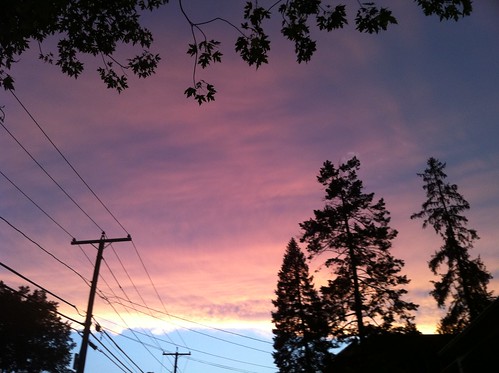
Outside, the sky turned dark yellow and the trees and grass seemed to all start glowing. I took a picture and posted it on Facebook and then I saw about ten more identical pictures from friends. People kept saying "that's a tornado sky!" but the meteorologist on the TV explained the yellow was really simply because the sun had gone below the horizon. Suddenly the TV switched to their skycam over Northampton, less than a mile from my sofa and the sky there was black, Intense thunderstorms were moving through. At my place, the wind whipped up once or twice and a few raindrops fell. From the front yard, I could see the edge of the storm just passing over me.
Lesa instant messaged me that it was dark as night and there was relentless lightning where she was. A woman who had left her building returned after being gone for two and a half hours. She was not able to get home.
I glanced out the window and two sparrows alighted on the bird feeder and just like that, the clouds blew over and the wind stopped. The temperature had dropped, the humidity was erased, and I got a message from Lesa that she was on her way to her car and heading home.
It was a harrowing and intense evening and I personally wasn't at any point really in the thick of any danger. I can't even imagine what it must have been like to those in the path of the tornado.
I'm so happy to live in a time when we can all connect and find out instant information so easily. Of course, you need electricity for that, but even in a black-out I'd have access with my phone, at least until the battery died. I was able to check up on friends south of me and to also answer friends who were checking up on me and Lesa. I was able to follow the path of the storms on the TV and on my computer and on my phone. It's magic.
Subscribe to:
Posts (Atom)